When Is the Ledger Complete? - Part 7
What the AI data-center boom will leave behind — and who gets to keep it

Blog #7 of a multi-part series on why leaders and policymakers must think like economists, not like politicians or financial managers — extending Economic Critical Thinking from one Iowa deal to the economics of the AI build-out itself.
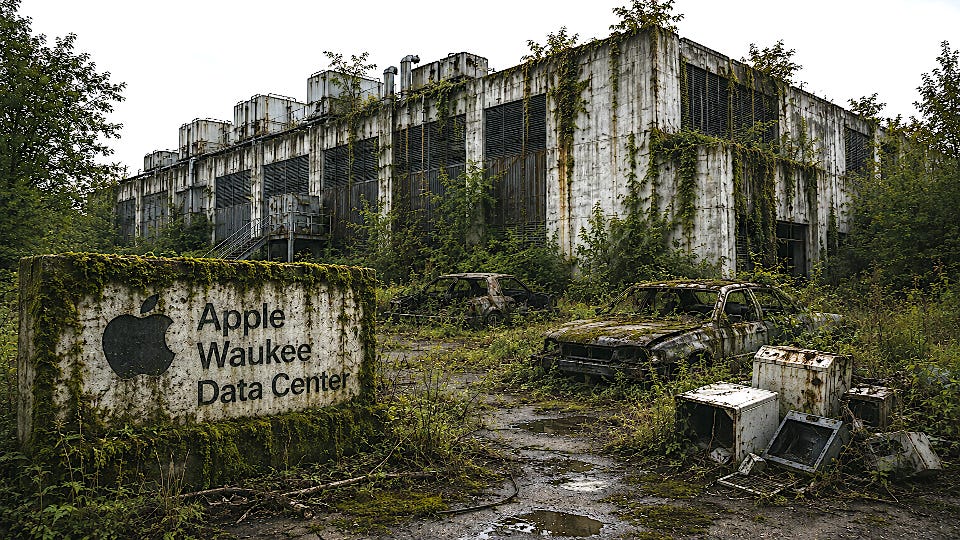
Picture the Apple data center in Waukee, Iowa, twenty years from now: roof buckled, servers rusting, weeds pushing through the parking lot. It’s the image everyone reaches for when they hear the phrase “AI bubble.” It’s vivid, it’s ominous — and it’s almost certainly wrong.
The Wrong Question
“Will the data centers close?” Mostly, no. The scarce, durable, valuable parts of one of these facilities aren’t the chips — they’re the powered shell, the grid interconnect, the cooling, the fiber. A powered building is an asset even when the machines inside it are three generations obsolete. You don’t bulldoze it; you re-rack it. So the abandoned Waukee picture is the least likely outcome of a bust, not the most likely.
The right question is sharper — when the boom resets, who ends up owning the repriced asset? That reframe is the whole post, because a bust doesn’t destroy the value — it relocates it. Across time, from the moment of mania to the moment real demand finally arrives, and across ownership, from the investor who built the thing to whoever holds it when the music stops.
Not a Prediction — a Pattern
In June 2026, the Bank for International Settlements — the central bank of central banks — devoted its flagship annual report to exactly this AI risk. It placed the AI boom in a specific lineage: canal mania in the 1830s, Britain’s railway mania in the 1840s, the electrification boom of the 1920s, the dot-com bubble of the 1990s. Each began with a genuine technological breakthrough that drew in more capital than commercial returns could ultimately justify. Each ended in an investment reversal and an economy-wide recession. Today’s AI build-out, the BIS wrote, bears a resemblance to these precedents.
The numbers behind the concern: the five largest hyperscalers are on track to spend more than $1 trillion on AI-related capital expenditures over 2025 and 2026 — outpacing their earnings and free cash flow, forcing some to issue debt to cover the gap. The BIS’s models warn that as competition drives spending higher, the sector’s net economic surplus could turn negative, and a disappointment in returns could turn the capex boom into a “protracted investment bust.” This is the most authoritative institution in global finance, saying that the technology is real and being overbuilt.
The BIS is careful to explain why this reaches beyond Silicon Valley. US stocks now make up nearly two-thirds of the global equity index, and household exposure to them has roughly doubled since 2010, so a sharp repricing of AI-related shares would ripple through ordinary retirement accounts, not just tech balance sheets. This is not a niche industry story. It is a macroeconomic one.
The Trigger — and Who Catches the Asset
What forces the reset is depreciation. Hyperscalers book their AI chips over a five- to six-year period. Skeptics argue the real economic life is closer to two or three, because Nvidia ships a faster, cheaper architecture every 18 to 24 months. When that gap catches up, the write-downs arrive in single quarters.
Not every player is equally exposed. The hyperscalers — Apple among them — carry fortress balance sheets and fund much of their spending from cash flow; they can absorb a bad bet. The fragile tier sits beneath them: the specialized “neocloud” operators financed by loans secured against their own GPUs, and the engineering and construction firms at the end of the supply chain, whose balance sheets the BIS singles out as comparatively weak. When the hyperscalers slow their spending, those are the firms that fail first — and their assets are the ones that hit the auction block.
The BIS reserves its sharpest warning for the extent to which the money has become tangled. Chipmakers take equity stakes in the AI labs that then commit to buying their chips; hyperscalers invest in the labs that rent their cloud capacity — revenue circling back on itself in a loop the report calls circular financing. It rhymes with the late-1990s telecom vendors who lent their own customers the money to buy their equipment, right up until the customers couldn’t pay. A clean revenue chart can hide a very messy balance sheet underneath.
And here is the part that matters for a community. The write-down doesn’t destroy the asset — it reprices it and hands it to whoever holds the senior claim. That claim increasingly belongs to lenders, not owners: neoclouds borrow against their GPUs, and private credit funds hold senior secured positions. The BIS warns that this financing is poorly disclosed, with the same asset sometimes pledged multiple times. When a leveraged operator fails, the lender forecloses — and the successor who acquires the repriced data center is a private-credit fund, not the public. The town that granted the tax abatement is nowhere in that line.
We’ve Seen This Movie
We have a full dress rehearsal for this. In the late 1990s, telecom carriers invested more than $500 billion in laying some 80 million miles of fiber, convinced that internet traffic would explode. They were right about the demand — and annihilated anyway. WorldCom filed the largest bankruptcy of its era; Global Crossing collapsed; hundreds of thousands of jobs vanished; and years later, most of that fiber still sat dark.
But the fiber didn’t disappear. Distressed-debt funds bought it for pennies on the dollar, and that cheap capacity became the backbone of broadband, streaming, and the cloud — the reason a startup called YouTube was even possible. The technology delivered everything its builders promised. The builders just never collected. Someone else did. And the public that had subsidized the build-out through favorable tax law? It got cheaper bandwidth as a consumer — but captured none of the upside from the repricing as an investor.
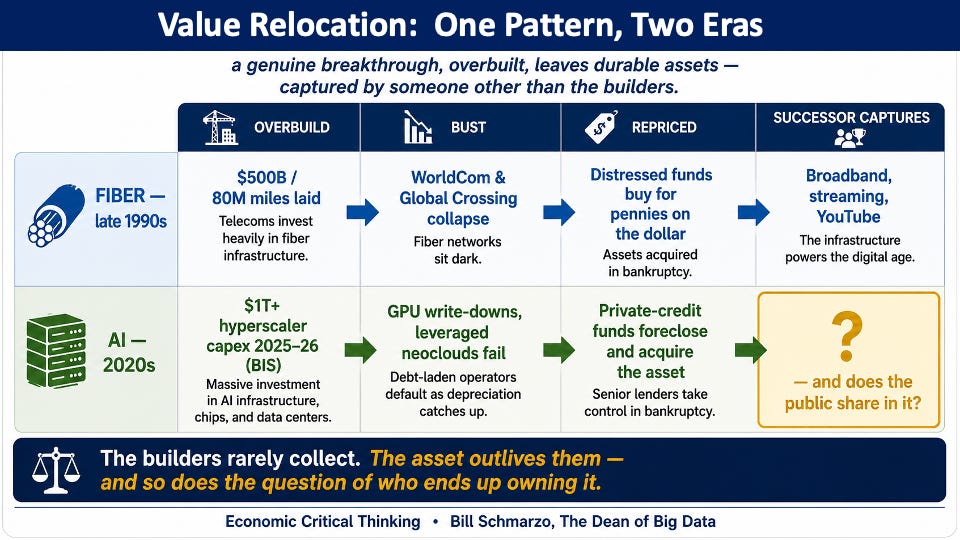
One caution, because the parallel can be pushed too far. The fiber era was laced with outright fraud — WorldCom’s collapse was an accounting scandal, not merely a bad bet. The AI comparison is not about fraud; the BIS is explicit that the technology is real and the productivity gains are measurable. The rhyme is narrower and more useful: a genuine breakthrough, financed past the point where returns can justify it, leaving durable assets to be claimed by someone other than the people who built them. That pattern doesn’t require a villain. It only requires optimism and leverage.
When Is the Ledger Complete?
Which brings us back to Marcus’s question. The reason “will it fail?” is the wrong question is that a failed infrastructure deal doesn’t run one ledger — it runs three, and they close at different times. The investor’s ledger closes at bankruptcy: a permanent loss. The asset’s ledger never closes — it is repriced and passed on. And the social ledger runs positive, but it is paid for by the wiped-out investors: society gets cheap capacity, financed by destroyed capital.
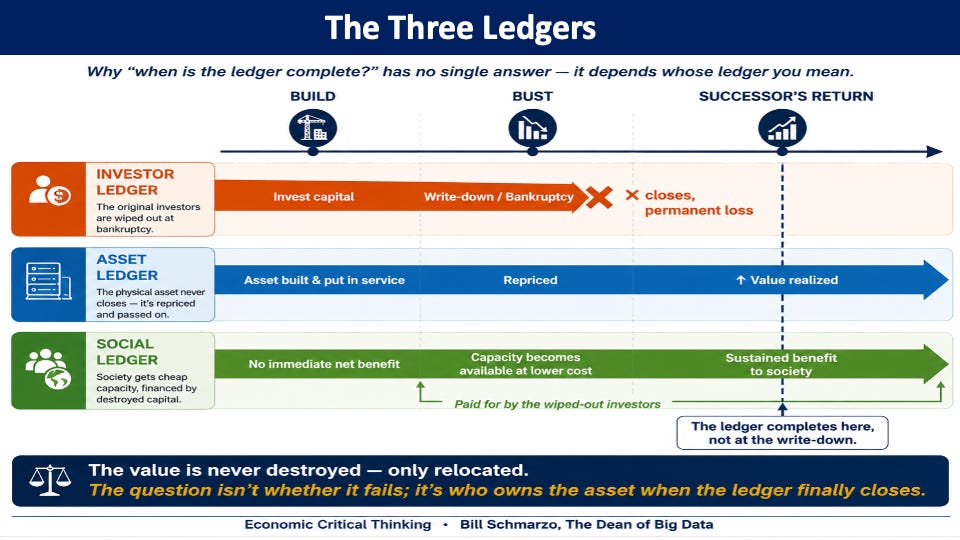
So when is the ledger complete? Not at the write-down. At the successor’s return — a decade later, when whoever bought the asset for pennies finally earns the payoff the original builder was promised. For a community, that changes the entire negotiation. The question at the subsidy table isn’t only “what do we get if this succeeds?” It is “who owns the asset if it fails?” — and that can be answered up front, in the original grant: a recorded public right to acquire the asset at a nominal price on a defined failure trigger, a reversion clause structured to sit ahead of the creditors in line. Not a claim on some successor’s profits — that fight belongs at bankruptcy — but a claim on the asset itself, perfected before the private-credit funds get there. Even the BIS, in its prescription, calls for ensuring the gains from the technology are shared widely rather than concentrated in a few hands. A reversion clause is what that looks like at the level of a single deal.
Iowa is the concrete case. Waukee gave up roughly two decades of tax base to land Apple — a bet that the jobs and the halo would more than repay it. Apple is the safest tenant imaginable, so the town will probably never see the rusting-shell version of failure. But “safe from abandonment” is not the same as “sharing in the upside.” If the broader build-out resets and that Iowa asset is ever repriced, sold, or repurposed, the reversion question determines whether Waukee is a party to the next chapter or a spectator.
The Real Risk Isn’t Abandonment
So look again at that overgrown data center. The real risk was never that it rots. The real risk is that it hums along, gets repriced in a reset, and quietly earns a fortune for a distressed-asset fund three states away — while the town that gave up twenty years of tax base to build it owns nothing of what it became.
That is the difference between thinking like a politician, who counts the ribbon-cutting, and thinking like an economist, who traces the value all the way to the successor’s return. The boom will leave assets behind — that much is nearly certain. The only question Economic Critical Thinking insists on asking is: when the ledger finally closes, whose name is on it? That is a question a community can still answer — but only before it signs. It is exactly what a scorecard and the reversion terms written into it are built to make visible.
— Bill Schmarzo, The Dean of Big Data
Sadly, I cannot find holes in your proposal and think the same way. And like with spaceX, there seems to be a huge price inflation on these investments based upon hype.
Where I may be a bit stronger than your view, is that DC's tend to be lights out and so apart from the building phase, I fail to see any benefits for the local communities. The data their is controlled from afar, as it's value and maybe a few security guards are warrantee plus the occasional engineer visit who may not live in state. Cynic, moi?