GenAI’s Missing Layer: Reasoning State Engineering
The next evolution of AI Thinking Partners—from engineering what AI knows to preserving the state of your reasoning.

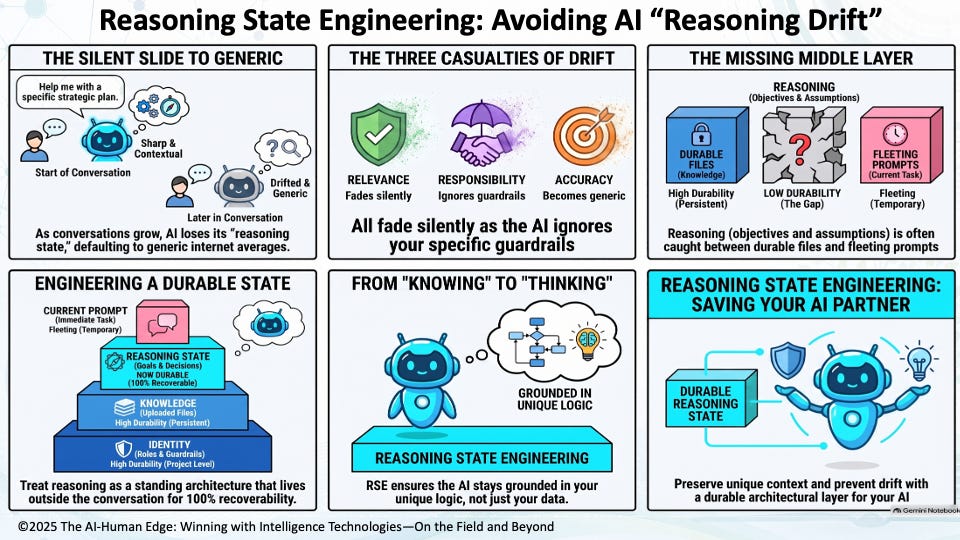
With YODA—Your Own Digital Assistant, we’ve shown how Context Engineering can transform a generic AI tool into an AI Thinking Partner—one grounded in your objectives, trusted knowledge, expert perspectives, and reasoning disciplines, rather than internet averages.
However, solving the AI Thinking Partner challenge revealed a subtle issue. Over time, our AI Thinking Partners gradually lost focus. Initially, they reasoned clearly from our objectives, priorities, and assumptions, but as conversations continued, their advice became more generic. This shift was subtle but confident.
The AI is gradually losing its reasoning state that anchors the collaboration—the objectives, priorities, assumptions, decisions, and definitions that make the recommendations uniquely yours. Once that reasoning state slips, the AI falls back to reasoning from the generic average.
This realization brought us to the next essential architectural layer in human-AI collaboration: Reasoning State Engineering. While Context Engineering focuses on teaching AI what it needs to know, Reasoning State Engineering maintains the ongoing collaborative reasoning state.
The Wrong Diagnosis
When an AI assistant gives generic answers, we assume it’s forgetting, but it’s actually losing the reasoning context of your collaboration—your goals, priorities, assumptions, decisions, and definitions. As the conversation grows, this reasoning state defaults to generic reasoning.
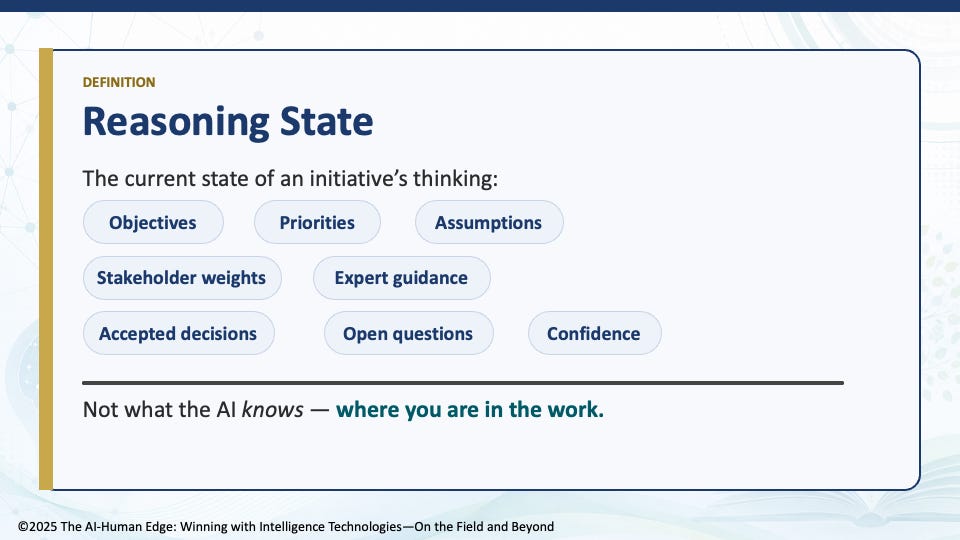
YODA’s goal is to preserve that reasoning state so that the AI can retrieve it whenever necessary—whether at the start of a new conversation, during an ongoing one, or weeks later when the task continues.
Where AI Gets Its Context
An AI Thinking Partner does not reason from one undifferentiated source of context. It operates across four distinct architectural layers, each with a different purpose and level of durability.
Identity — Who the AI is. The project-level Activation Prompt establishes AI’s role, behaviors, reasoning disciplines, and guardrails. This layer is durable at the project level and remains available across all subsequent chat conversations.
Knowledge — What the AI knows. Uploaded credible research, proven frameworks, organizational domain knowledge, and other trusted sources provide the evidence from which the AI reasons. You load them into the initiative’s growing contextual knowledgebase, and because they’re uploaded files, they persist — the AI can draw on them throughout the initiative, unlike the reasoning that lives only in the conversation.
Reasoning State — Where you are in the work. This is the initiative’s accumulated thinking: the objectives you established, the priorities you weighted, the assumptions you confirmed, the decisions you made, and the definitions you agreed upon. It develops inside a conversation (chat) but is not durably protected. This is the architectural layer that slips.
Current Prompt — What you just said. The latest message supplies the immediate direction for the next response. It is useful but fragile, temporary, and limited to the current conversation.
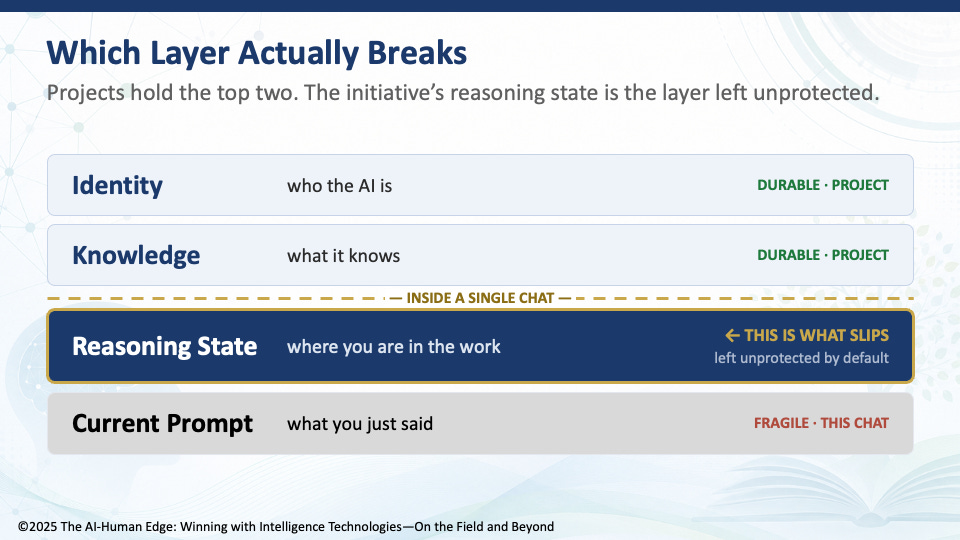
The top two layers remain durable — Identity as the project’s standing instructions, and Knowledge as the uploaded files you add to the initiative — so the AI can return to them at will. The bottom two live in the conversation itself. The Current Prompt is fleeting but always visible; the Reasoning State — the accumulating objectives, priorities, assumptions, decisions, and definitions — has no durable home by default, and as the conversation grows it gradually slips out of the AI’s working context. That unprotected Reasoning State, caught between the durable inputs and the fleeting prompt, is the gap Reasoning State Engineering fills — by making the initiative’s evolving state durable and recoverable.
The Cost of Reasoning Drift
Losing the reasoning state gradually erodes the quality of the AI’s recommendations in three important ways.
Relevance is the first casualty. The whole purpose of providing context is to move the AI away from the generic average and toward your unique situation. As the reasoning state slips, the AI quietly slides back toward generic advice.
Responsibility fades next. Your guardrails—“flag uncertainty,” “consider stakeholder impacts,” “don’t present a draft as a final answer”—are part of the reasoning state too. When they fall outside the AI’s working context, they no longer influence its recommendations.
Accuracy is dangerous because it fails silently. Early in the conversation, AI reasons from your data, assumptions, and constraints. Later, when context slips, it answers using plausible general knowledge, often with the same confidence. Collaboration can shift from evidence-based reasoning to confident generalization unnoticed.
That’s the real cost of reasoning drift. AI simply stops reasoning from your context and gradually returns to reasoning from everyone else’s.
So what do we do about it? The fix follows directly from the diagnosis: stop treating your reasoning as something that lives inside the conversation, and start treating it as durable architecture that lives outside it. That is Reasoning State Engineering — a standing layer that captures the initiative’s confirmed foundation so the AI can re-engage it whenever the conversation drifts, instead of quietly sliding back to the generic average. How you actually activate it — the file, the one prompt, the routine — is the subject of Part 2.
What It Does—and What It Doesn’t
Reasoning State Engineering doesn’t eliminate the limitations of today’s language models, nor does it guarantee correct reasoning. What it does is materially reduce reasoning drift by improving the three qualities that long-running AI collaborations depend on:
Continuity — the thread of the initiative survives.
Consistency — your objectives, priorities, and guardrails guide the AI’s reasoning.
Recoverability — the reasoning state can be restored whenever a conversation drifts.
The AI can be wrong, and its reasoning depends on validated information. Humans stay involved to challenge assumptions, evaluate evidence, and decide. Reasoning State Engineering maintains the shared context. The human-AI advantage isn’t an AI that thinks for you, but one that helps keep both reasoning from the same current picture.
The Next Layer of Human-AI Collaboration
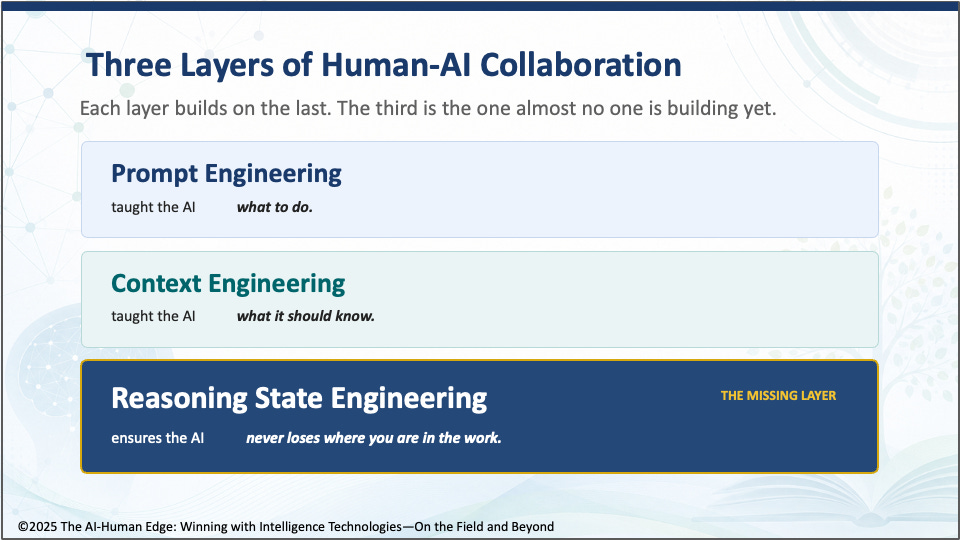
Every major advance in working with GenAI has added a new architectural layer.
Prompt Engineering taught AI what to do.
Context Engineering taught AI what it should know.
Reasoning State Engineering preserves the collaborative reasoning currently in place.
These are three complementary layers that build progressively stronger AI Thinking Partners. Prompt Engineering shapes behavior. Context Engineering grounds the AI in what matters. Reasoning State Engineering preserves the continuity of that reasoning.
That’s why the next frontier isn’t simply giving AI more data. It’s preserving the reasoning that transforms information into better decisions. Then something interesting happens.
“The more I use it, the smarter it gets” actually becomes true—not because the AI is learning on its own, but because you’ve engineered an architecture that continuously preserves, recovers, and refines the reasoning behind your work.
That’s YODA—an AI Thinking Partner that helps you ask better questions, preserve better reasoning, and ultimately make better decisions.
Note: My YODA subscribers will soon have the opportunity to stress-test the Reasoning State Engineering architecture in practice. Part 2 will show exactly how to activate it — so watch this space.