Anthropic Calls It Context Engineering. Y.O.D.A. Calls It Building AI Thinking Partners.
Anthropic’s engineers just published the technical framework behind the central premise of Y.O.D.A.: The Context Engineering Playbook

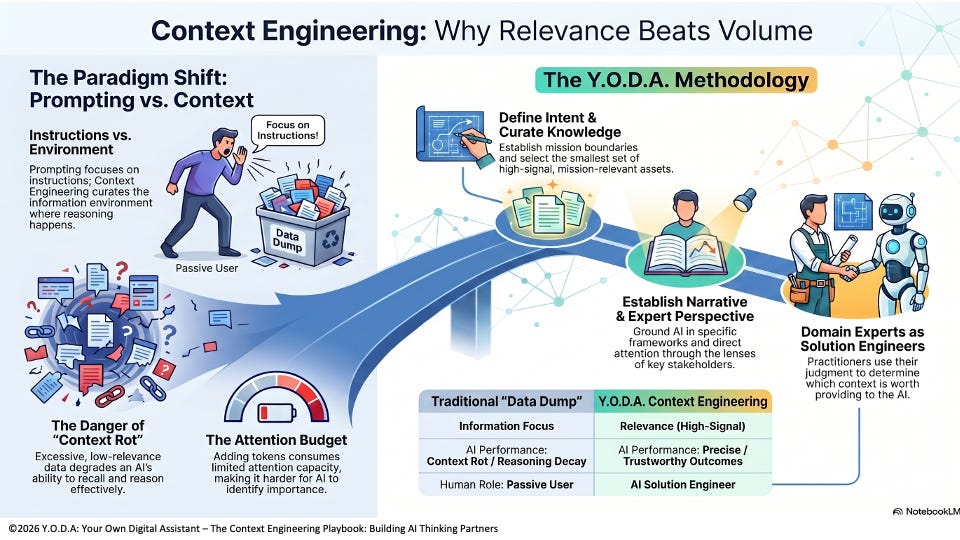
Recently, Anthropic’s Applied AI team published a detailed engineering paper titled Effective Context Engineering for AI Agents. Their conclusion was profound: AI systems perform better when they are given the smallest possible set of highly relevant information rather than massive amounts of loosely related content.
I found this paper rewarding because Anthropic’s results confirm a principle I’ve long supported: AI’s value depends on providing the right information, not just more data.
Relevance always surpasses volume.
That principle sits at the heart of my upcoming book:
📘 “Y.O.D.A. (Your Own Digital Assistant): The Context Engineering Playbook – Building AI Thinking Partners.”
One of the book’s central arguments is that most organizations focus on improving prompts when they should be focused on improving context. Better prompts may improve an interaction. Better context improves the quality of reasoning.
As organizations begin integrating AI into decision-making, the competitive advantage shifts to context engineering. Success depends on defining the objectives, constraints, stakeholders, expertise, and knowledge that shape how the AI reasons about a problem.
That is precisely why Anthropic’s paper caught my attention. What their engineers now call Context Engineering is consistent with what YODA has been operationalizing from the beginning—a pragmatic methodology that enables domain experts to systematically guide AI reasoning toward more relevant, trustworthy, and actionable outcomes.
During a recent AI Value Workshop, one participant observed that we were essentially turning domain experts into “AI Solution Engineers.” I loved that description because it perfectly captures what I believe is the next stage of AI adoption.
The future of AI depends on domain experts who understand how to create value in customer engagement and operations. They know customer needs, constraints, trade-offs, and decisions that drive outcomes. As AI advances, the advantage shifts from access to technology to providing users with the right context. Organizations that train experts to engineer this context will outperform those treating AI as just a productivity tool.
YODA provides a structured methodology for doing exactly that—helping practitioners transform their expertise, judgment, and experience into AI thinking partners that deliver more relevant, trustworthy, and actionable outcomes.
What Anthropic Said (And Why It Matters)
Anthropic’s engineers make a simple but important distinction: Prompt Engineering is about writing the right instructions. Context Engineering is about creating the right information environment.
They define Context Engineering as:
“Context engineering refers to the set of strategies for curating and maintaining the optimal set of tokens (information) during LLM inference—including all the other information that may land there outside of the prompts.”
While that may sound technical, the underlying idea is surprisingly intuitive. The quality of AI reasoning is determined not only by the prompt but also by everything else the model must attend to while generating its response.
This paper highlights ‘context rot,’ where increased information in the context window hampers the model’s recall and reasoning. More data often worsens outcomes rather than improving them, as Anthropic’s engineers advise.
“Find the smallest possible set of high-signal tokens that maximize the likelihood of some desired outcome.”
In other words:
The goal is not to provide more information. The goal is to provide the information that matters most to the decision, recommendation, or action you are trying to drive.
This is crucial in applied AI, challenging the idea that more context always helps. Anthropic’s engineers argue better context beats more, linking to YODA.
Three Convergence Points You Should Not Miss
Anthropic’s framework validates several of the core principles that have guided the YODA methodology from the beginning. Three connections, in particular, stood out.
1. “Context Rot” Validates YODA’s Curation Principle
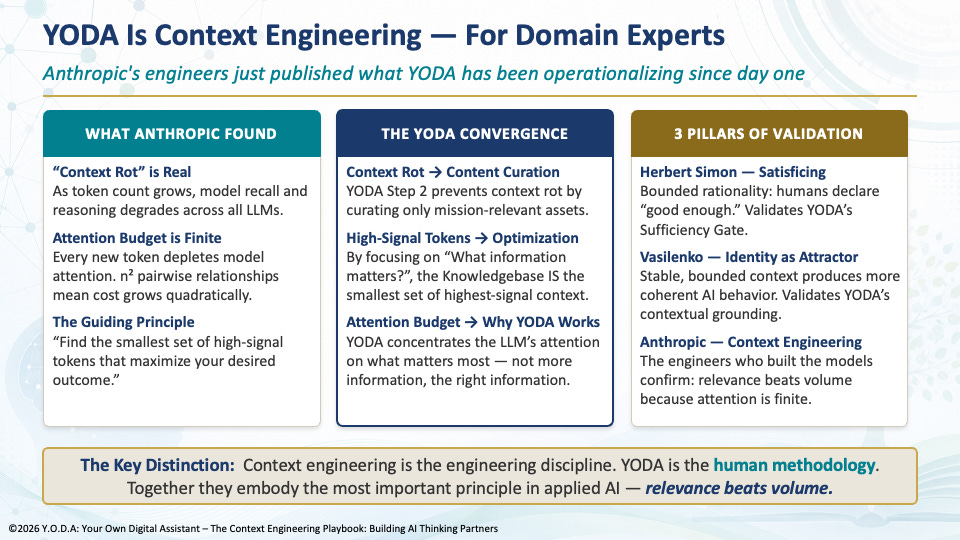
YODA’s principle is relevance over volume, not just giving more data. Anthropic’s research shows that as context grows, AI’s ability to recall and reason degrades—a phenomenon called ‘context rot.’
Feeding AI excessive information doesn’t make it smarter; often, it’s less effective. YODA’s Contextual Knowledgebase is a curated environment, not a data dump, designed to focus on what matters.
2. “High-Signal Information” Is YODA’s Contextual Knowledgebase
Anthropic’s principle is to find the smallest set of information that maximizes the likelihood of success, paralleling YODA Step 2: Build the Contextual Knowledgebase. YODA starts with asking, “What information matters?” not “What data do we have?”
The goal isn’t more info, but the most relevant info for decisions or actions, requiring intentional curation aligned with objectives, stakeholders, constraints, and environment. This isn’t engineering but a structured human judgment process.
3. “Attention Budget” Explains Why YODA Works
Anthropic explains that adding information to the context window uses up the model’s limited attention capacity. As context grows, it becomes harder for the model to identify what is truly important, since it must evaluate more relationships. This supports a principle I’ve taught: knowledge isn’t about more data, but about relevant data.
YODA works because it narrows the model’s focus to information most relevant to goals, stakeholders, constraints, and decisions. Instead of averaging everything, it zeroes in on what matters most. You’re not giving the AI more things to think about; you’re giving it the right things.
YODA Is the Human-Facing Methodology for Context Engineering
Anthropic’s paper highlights an important engineering challenge, but it leaves largely unanswered an equally important question:
How do practitioners determine what information belongs in the context in the first place?
Context engineering, as Anthropic frames it, is primarily an engineering discipline focused on how developers configure AI systems. But most of the people who need to work effectively with AI are not AI engineers. They are care providers, educators, analysts, consultants, clinicians, technicians, sales leaders, and domain experts who need a structured way to bring their expertise into the AI interaction.
That is precisely what YODA was designed to do.
Over the past several years, I have refined and taught the YODA methodology in executive workshops, corporate innovation programs, and university classrooms, including courses at Iowa State University and Coe College. The goal is to help domain experts become AI Solution Engineers by teaching them how to systematically define objectives, curate knowledge, and incorporate expertise that guide AI reasoning.
YODA operationalizes context engineering for humans through a five-step methodology:
Step 1: Define Intent & Objectives — Establish the mission boundary that determines what is relevant.
Step 2: Build the Contextual Knowledgebase — Curate the smallest set of high-signal, mission-relevant knowledge assets.
Step 3: Establish the Intelligence Narrative — Ground the AI in the frameworks, assumptions, values, and reasoning disciplines that matter.
Step 4: Leverage Experts’ Knowledge — Direct the AI’s attention through the perspectives of the stakeholders and experts who matter most.
Step 5: Synthesize, Recommend & Explore — Generate recommendations, evaluate confidence, explore alternatives, and iterate while keeping humans accountable for every decision.
Anthropic describes effective context engineering as creating “the minimal set of information that fully outlines expected behavior.” YODA offers a methodology for determining that information. Thus, Anthropic and YODA address complementary issues: Anthropic explains how context influences AI behavior, while YODA helps identify which context is worth providing.
More Evidence That YODA Is Pointing in the Right Direction
I’m more confident in the YODA methodology because its principles are independently validated by unrelated disciplines. These researchers, unaware of YODA, arrive at similar conclusions.
Herbert Simon’s theory of bounded rationality and satisficing reinforces YODA’s Sufficiency Gate. Humans rarely optimize perfectly. Instead, they seek solutions that are sufficiently informed, reliable, and actionable given the available information.
Vasilenko’s Identity as Attractor research reinforces YODA’s emphasis on identity, context, and narrative. Stable identities and bounded contexts create more coherent, consistent, and reliable AI behavior.
Anthropic’s Context Engineering framework reinforces YODA’s curation-over-volume principle. Relevance beats volume because attention is finite, context rot is real, and effective reasoning depends on focusing on what matters most.
Each of these insights is interesting on its own, but when seen together, they become hard to overlook.
A Nobel laureate economist exploring human decision-making. An AI researcher investigating identity and reasoning consistency. And engineers developing some of the most advanced AI systems globally. Different fields. Different questions. Different approaches. Yet all three arrive at a remarkably similar conclusion:
The quality of outcomes depends less on the quantity of information available and more on how effectively attention is focused on what matters.
This is compelling evidence that the principles underlying YODA align with how humans and AI systems reason and make effective decisions.
The Bottom Line
Anthropic’s engineers describe Context Engineering as a key technical discipline, while YODA focuses on the equally vital human aspect. Context engineering clarifies how different contexts affect AI behavior, and YODA offers a structured method to identify which contexts are most valuable to include.
Whether you are a business leader, educator, analyst, consultant, clinician, or engineer, the principle is the same:
The goal is not to provide more information. The goal is to provide the information that matters most.
That is the central premise behind Y.O.D.A.: Your Own Digital Assistant – The Context Engineering Playbook.
Relevance beats volume. Every time.
⚽️ GGGOOOOAAAAALLLLLLLLLL! 🥅