WTF! IBM Hiring MORE Entry-level Professionals? Did IBM Just Validate The AI-Human Edge?
AI: Replace You — Or Accelerate Your Potential?

Every few months, a headline screams that AI is about to eliminate human workers. This week, Microsoft AI CEO Mustafa Suleyman predicted that “artificial intelligence can replace most white-collar work in the 12 to 18 months”. That makes for great headlines, but not responsible leadership.
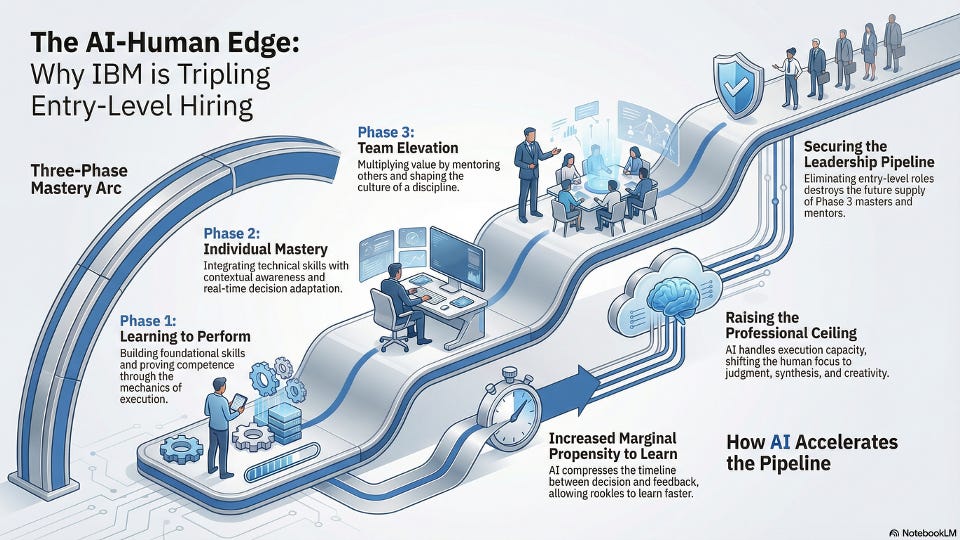
And then, almost quietly — almost inconveniently — IBM flew in the face of that narrative and announced that it is tripling entry-level hiring.
In a week when pundits are forecasting the extinction of white-collar jobs, IBM — one of the more experienced enterprise AI organizations — is expanding its early-career workforce. Why? Why is IBM making a decision that runs counter to what all of the Tech Bro’s are telling the world about the future of humans and AI?
IBM, like a small but growing number of organizations, has realized the true power of AI isn’t in automating humans out of work, but instead, accelerating human development by amplifying domain expertise and unleashing human creativity.
And that is a direct validation of the central thesis of my latest book, “The AI-Human Edge: Winning with Intelligence Technologies—On the Field and Beyond.”
The Narrative That IBM Just Broke
The prevailing story in tech circles is seductive and overly simplistic:
AI designs software and writes code.
AI drafts contracts and briefs
AI builds financial and operating models.
AI produces marketing and sales content.
And much, much more.
Therefore, AI replaces humans in those roles.
However, this assumption presumes that domain expertise is simply a checklist of tasks—do this, then do that. In reality, developing expertise and elevating discipline follow a developmental arc.
In my “Moving Beyond Moneyball” blog series, I describe how Randy Johnson evolved from an erratic flamethrower into a Hall of Fame pitcher. His early volatility was not a liability — it was a developmental signal. Mastery emerged through coaching, feedback, refined judgment, and disciplined learning cycles.
The same principle applies across various professions. Early-career nurses, teachers, architects, therapists, detectives, and social workers should not be viewed as risks to be minimized; rather, they are talent in development. Their differences are due to ongoing experience growth — not a lack of ability.
Achieving professional excellence follows a consistent three-phase arc:
Phase 1: Raw Talent — Learning to Perform
This is the apprenticeship stage where humans build foundational skills, absorb domain knowledge, and learn the mechanics of execution. The focus is competence — proving you can execute tasks reliably and understand the rules of the game.Phase 2: Individual Mastery — Activating Full Personal Value
This is the proficiency stage. Technical skill becomes integrated with contextual awareness. Professionals move from following playbooks to interpreting situations. They understand cause-and-effect relationships, anticipate consequences, and adapt decisions in real time.Phase 3: Team Elevation — Multiplying Value Through Others
This is the leverage stage. Mastery extends beyond individual output to developing, mentoring, and amplifying the performance of others. Professionals shape culture, set standards, and transfer judgment to their discipline.
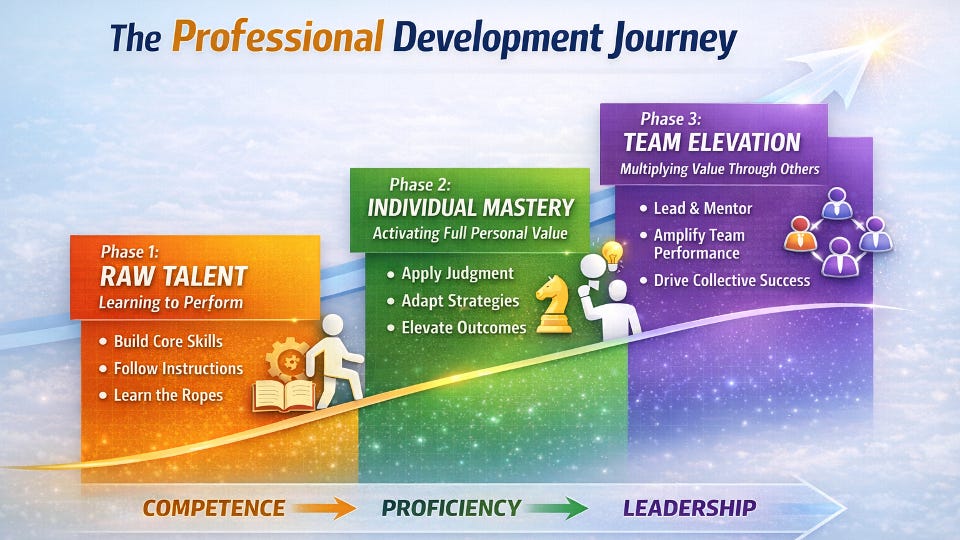
AI, when properly designed, accelerates this journey. IBM appears to have learned that.
What IBM Likely Discovered About GenAI
IBM’s hiring decision suggests that they’ve internalized something subtle but profound about Generative AI:
1. GenAI Automates Execution, Not Accountability
The mistake most pundits are making is treating domain expertise as a collection of tasks rather than as a system of human-based economic assets. AI has proven it can successfully optimize key operational processes, especially when executed in closed-loop environments.
But in real-life, open environments like the real world, AI and other analytics techniques struggle to understand situational context and leverage the human intuition and experience to:
Accept accountability when outcomes carry legal, financial, or societal consequences.
Build and sustain stakeholder trust in environments defined by uncertainty and risk.
Redesign systems when the objective itself must evolve, not just be optimized.
Imagine new categories of value beyond what the historical data suggests.
Integrate intuition, ethics, experience, and creativity into responsible judgment.
That distinction is everything. AI may reduce execution costs, but more importantly, it increases the economic value of sound professional judgment.
2. Eliminating Entry-Level Roles Destroys Domain Mastery Pipeline
If you eliminate Phase 1 of professional development, where domain experts are first identified and formed, you eliminate future Phase 3 leaders. Professional mastery is built through:
Exposure to messy, real-world complexity.
Learning under supervision.
Making mistakes and correcting them.
Gradually refining judgment.
In the AI Career Advisor materials, I emphasize a guardrail: AI should reduce noise without short-circuiting productive struggle. If AI removes early-career professionals entirely, organizations create a vacuum:
No internal development.
No cultural continuity.
No tacit or tribal knowledge formation.
No future mentors.
Leading organizations understand that AI makes rookies more productive faster, but rookies still need to exist to evolve into All-Stars and Hall of Fame performers.
3. AI Increases the Marginal Propensity to Learn
This is the economic lens that most commentators miss: AI increases learning velocity, shrinking the time between decision, feedback, and adaptation, thereby compounding value creation. Entry-level professionals who once took three years to internalize pattern recognition can now compress that timeline dramatically through:
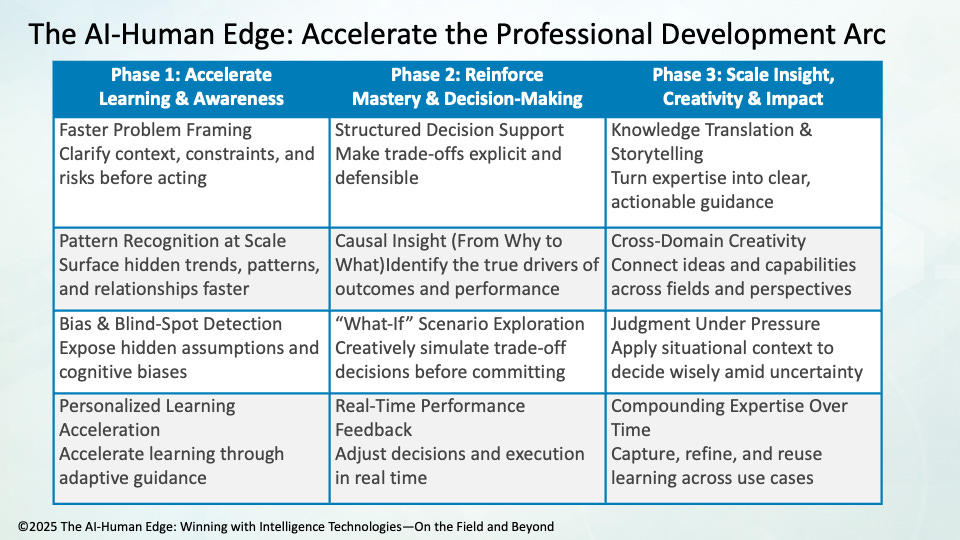
Pattern Recognition at Scale — Exposing professionals to a broader range of cases, edge conditions, and outcome variations than they would encounter naturally, accelerating experiential learning.
Faster Problem Framing — Helping professionals clarify the real problem more quickly by structuring ambiguity, surfacing assumptions, and distinguishing signal from noise.
Bias & Blind-Spot Detection — Identifying cognitive biases, missing variables, and overlooked perspectives that might otherwise distort judgment.
Personalized Learning Acceleration — Adapting feedback and development pathways to the individual’s strengths, gaps, and performance patterns, compressing the time to proficiency.
AI increases the Marginal Propensity to Learn (MPL)—the rate at which an individual or organization improves with each additional decision or interaction. When every action yields usable insight that informs the next, performance compounds. Organizations with a higher MPL convert experience into capability faster than competitors.
4. AI Raises Your Professional Ceiling
When AI can draft, simulate, analyze, and stress-test at machine speed, the ceiling for the domain expert shifts upward. The constraint is no longer execution capacity. The constraint becomes judgment, synthesis, creativity, and system-level thinking.
In Phase 2 of professional mastery, AI becomes a developmental accelerant by reinforcing:
Structured Decision Support — Clarifying assumptions and organizing complexity so professionals can operate at a higher cognitive level.
Causal Insight — Deepening understanding of why outcomes occur, enabling smarter interventions instead of reactive corrections.
“What-If” Scenario Exploration — Expanding strategic imagination by safely exploring alternative futures before committing resources.
Real-Time Performance Feedback — Compressing the learning loop so refinement happens continuously, not retrospectively.
These capabilities accelerate the transition from experience to expertise. The result is not task replacement, but capability expansion. AI does not flatten professional development. It raises the ceiling.
5. AI-Native Talent Is a Strategic Asset (and a Growth Mindset)
The most valuable professionals in the future will be those who approach AI with disciplined curiosity — experimenting boldly, learning quickly, and refining continuously. They will prototype ideas, challenge assumptions, and refine continuously. AI-natives:
Understand AI’s limitations — recognizing bias, brittleness, hallucination risk, and model constraints without becoming paralyzed by them.
Question its assumptions — probe outputs, stress-test reasoning, and validate conclusions rather than outsourcing judgment.
Use it to expand imagination and fuel curiosity — running simulations, exploring counterfactuals, and prototyping ideas faster than human cognition alone would allow.
Combine it with domain expertise — layering contextual knowledge, ethical responsibility, and lived experience on top of machine-generated insight.
This requires a growth-oriented mindset to experiment, observe, adapt, and improve — increasing their learning velocity with every interaction. Over time, that learning compounds into a strategic personal and professional advantage.
Conclusion: The Deeper Economic Perspective
The deeper AI economic story is about the acceleration of learning. AI compresses the distance between action and insight, between decision and feedback, between effort and improvement. It raises expectations because accountability remains human. It rewards disciplined curiosity because experimentation compounds into judgment. And it increases the rate at which professionals convert experience into refined capability. In that shift, competitive advantage moves away from task execution and toward adaptive mastery.
Organizations that understand this will stop asking, “How much labor can AI replace?” and start asking, “How much faster can our people learn?” The winners of the next decade will be those who deliberately design environments that amplify learning, experimentation, and ownership of outcomes. AI elevates professional standards. The economic edge belongs to those who use AI to accelerate the development of domain expertise and unleash human curiosity.
That, my friends, is “The AI-Human Edge”.